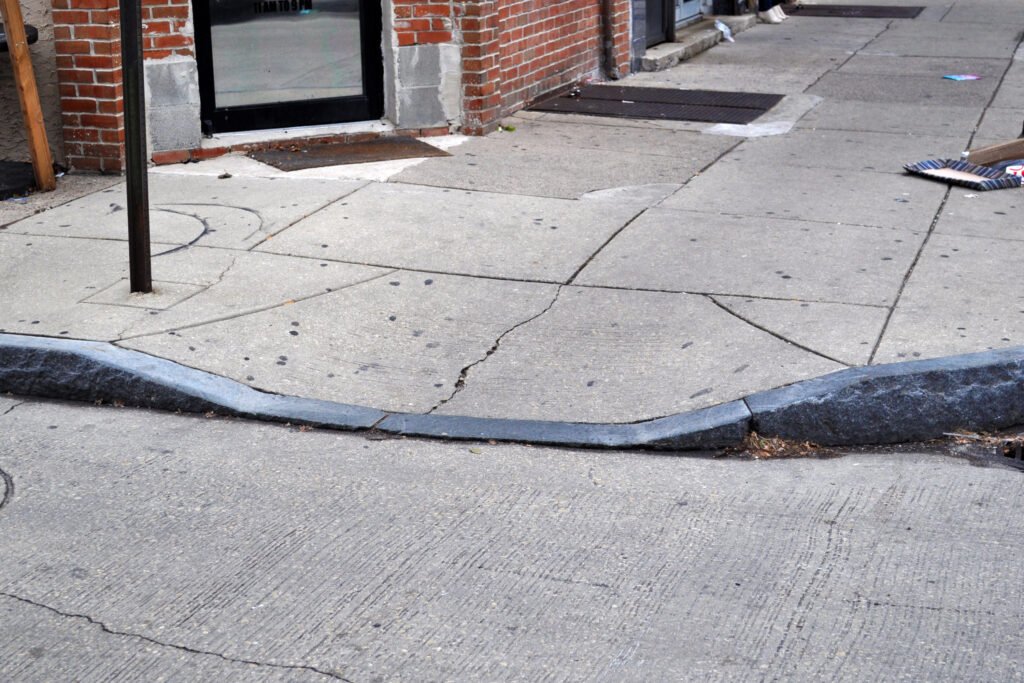
Who among us, when walking down the street, has noticed those useful little bits in the pavement where the level of the kerb drops down to the road? I would say most of us, for sure. For those of us living under rocks, it’s called a kerb cut. The purpose of these is simple – to make it easy for wheelchair users to cross the road.
That said, lots of other people find them useful as well. As a new parent, I find myself looking for them when I take my baby out for a walk in their buggy. It’s so much easier than having to turn around, drop into the road, somehow develop eyes in the back of my head, and then cross the road, and then repeat the whole process, backwards. But it’s not only parents who find these useful. Cyclists dismounting and then wheeling their bikes along a pavement, or people with suitcases find kerb cuts useful as well.
Another one is TV subtitles. They allow deaf or hard-of-hearing people to follow along with the action, understanding what people are saying without having to rely on lip-reading or the sign-language-interpreted versions of a programme that come out later on. Subtitles are also used within the neurodivergent community, allowing us to follow along if we have audio processing issues. They also find a use for new parents, allowing us to watch TV while our baby sleeps.
And that’s the definition of the kerb cut effect. It’s where disability-friendly features such as kerb cuts, subtitles, text-to-speech applications, AI note-taking, and many others are used and appreciated by a larger group than the people they were originally designed for.
Speaking of AI note-taking, the current UK Health Secretary James Murray is backing the use of AI ambient voice technology across the NHS to automate clinical note-taking and reduce administrative burdens. The idea is that the tool will allow clinical staff to spend up to 25% more time with patients, which is honestly a very good idea. The questions here are where the data will be hosted and who has it; I really hope it isn’t Palantir. But I’m going off-topic, typical of an ADHD person like me…
Anyways. The increased use of AI note-taking is really taking off. I’m training a lot of people to use this technology so they can record meetings and externalise the cognitive burden of note-taking, allowing them to be more present. My hypothesis is that the more this technology is used in the NHS, the more acceptable and normalised it will be for neurodivergent people to use this in their day-to-day working life as well.
The kerb cut effect in action, this time in reverse.
When we design for people who are likely to be excluded, we make things better for everyone.